STAKGEN - New Algorithm

Low Cost VPS Server

468x60 HNTHold HEC Helium Cloud Mining
Showing posts with label Kosher. Show all posts

Monday, May 8, 2023

Halal Spot In Oregon

Oregon is known for its beautiful landscapes, rich culture, and diverse cuisine. As the Muslim population in Oregon grows, so does the demand for halal food options. In this blog post, we will explore some of the best halal spots in Oregon.

Nicholas Restaurant - Portland
Nicholas Restaurant is a family-owned Lebanese restaurant that offers a wide selection of halal options. They have a separate halal menu that includes dishes such as shawarma, falafel, and kebabs. Their food is made fresh daily, and they use only high-quality ingredients. Nicholas Restaurant also offers vegan and gluten-free options.

Sultan's Mediterranean Cuisine - Beaverton
Sultan's Mediterranean Cuisine is a family-owned restaurant that offers a variety of halal options. They use only fresh ingredients and cook their food to order. Their menu includes dishes such as shawarma, falafel, and kebabs. They also offer vegetarian and vegan options.

Zaalook - Portland
Zaalook is a Moroccan restaurant that offers halal options. Their menu includes dishes such as lamb tagine, chicken couscous, and harira soup. They also offer vegetarian and vegan options. Zaalook is known for its authentic Moroccan flavors and cozy atmosphere.

Pambiche - Portland
Pambiche is a Cuban restaurant that offers halal options. They have a separate halal menu that includes dishes such as arroz con pollo and ropa vieja. Pambiche is known for its vibrant colors and lively atmosphere.

Yemeni House Restaurant - Salem
Yemeni House Restaurant is a family-owned Yemeni restaurant that offers halal options. Their menu includes dishes such as lamb haneeth, chicken mandi, and lamb kabsa. Yemeni House Restaurant is known for its authentic Yemeni flavors and warm hospitality.

In conclusion, Oregon offers a variety of halal food options for Muslim consumers. From Lebanese and Moroccan to Cuban and Yemeni, there are many restaurants that cater to the halal market. These halal spots in Oregon offer high-quality, delicious food that meets the halal requirements.


Sunday, May 7, 2023

Next Step In Halal Certifications

Halal certification has become increasingly important in the global food industry due to the growing demand for halal products among Muslim consumers. Halal certification ensures that products are produced and processed in accordance with Islamic law, and that they are free from any ingredients or practices that are not permissible under Islamic law. While halal certification has come a long way in recent years, there are still several areas for improvement and innovation. Here are some of the next steps in halal certification:

Standardization: One of the biggest challenges in halal certification is the lack of standardization. There are several halal certification bodies around the world, each with their own standards and guidelines. This can make it difficult for producers and consumers to navigate the halal certification process. The development of international halal standards and guidelines would help to address this challenge.

Transparency: Halal certification bodies need to be more transparent about their certification processes, including the criteria used to determine whether a product is halal or not. This would help to build trust among consumers and producers, and would also help to address concerns about the potential for fraud and misuse of halal certification.

Technology: Technology can play an important role in halal certification, particularly in areas such as traceability and supply chain management. Blockchain technology, for example, could be used to create a secure, transparent, and tamper-proof record of halal certification, making it easier to track products from farm to fork.

Capacity building: There is a need for more capacity building and training in halal certification, particularly in developing countries where the halal industry is still in its early stages. This would help to build local expertise and knowledge, and would also help to ensure that halal certification processes are being implemented effectively and efficiently.

Consumer education: Finally, there is a need for more consumer education and awareness about halal certification. Many consumers are still unaware of what halal certification means and how it is applied. By providing more education and information, consumers can make more informed choices about the products they purchase and consume.

In conclusion, halal certification has come a long way in recent years, but there is still much work to be done. By focusing on standardization, transparency, technology, capacity building, and consumer education, we can continue to improve and innovate in the field of halal certification, and ensure that halal products are produced and consumed in accordance with Islamic law.


Tuesday, March 7, 2023

Halal Pizza In United States

There are several pizza brands in the United States that offer halal options. Some popular halal pizza brands in the USA include:

  1. Pizza Paradise: This is a chain of halal pizza restaurants with locations in several states across the US.
  2. Halal Guys: While primarily known for their gyro and chicken platters, The Halal Guys also offer a range of halal pizzas at select locations.
  3. Zabihah Halal Pizza: This is a small chain of halal pizza restaurants with locations in California.
  4. Pizza Roma: This is another chain of halal pizza restaurants with locations in several states across the US.

It's important to note that not all locations of these pizza brands may offer halal options, so it's best to check with the individual restaurant to confirm. Additionally, there may be other regional or local halal pizza brands available in different parts of the country.


The Growing Market for Halal Business in the United States

The Growing Market for Halal Business in the United States

Introduction:

The term "Halal" refers to foods that are permissible according to Islamic law. Halal products are becoming increasingly popular in the United States, as more consumers are seeking out products that meet their dietary and religious requirements. In this journal, we will discuss the growing market for Halal business in the United States and the opportunities it presents for entrepreneurs.


Market:

The Halal market in the United States is expected to reach $52 billion by 2023, according to the State of the Global Islamic Economy Report. This growth is driven by an increasing Muslim population in the United States, as well as non-Muslim consumers who are seeking out Halal products for their perceived health benefits and ethical sourcing.

Opportunities:

The growth of the Halal market in the United States presents opportunities for entrepreneurs to tap into this market and offer Halal products and services. This includes food and beverage products, cosmetics and personal care products, and even tourism services that cater to Muslim travelers.

Certification:

To tap into the Halal market, businesses must obtain Halal certification from a recognized certification body. This certification ensures that the products and services meet the requirements of Islamic law, and provides reassurance to consumers that the products are Halal.

Challenges:

One of the main challenges of entering the Halal market is the cost of obtaining Halal certification. This can be a significant barrier for small businesses and startups, as certification can be costly and time-consuming. Additionally, there is a lack of awareness and understanding of the Halal market among non-Muslim consumers, which can limit the potential customer base for Halal products and services.

Conclusion:

The growing market for Halal business in the United States presents opportunities for entrepreneurs to tap into this market and offer Halal products and services. While there are challenges to entering this market, such as the cost of certification and a lack of awareness among non-Muslim consumers, the potential for growth and profitability is significant. As the Halal market continues to grow, businesses that can meet the needs of Muslim consumers and appeal to non-Muslim consumers will be well-positioned for success.

Tuesday, May 4, 2021

Tre Alfieri Halal - Italian Halal Supplier

Italy’s first-ever ‘halal’ supplier has opened for business in Italy’s northern city of Bologna, selling meals prepared according to Islamic principles to restaurants and canteens in Italy and abroad.

“Integration is also being able to eat as one should and to be at peace with God,” Hamza Piccardo, told Adnkronos International (AKI).

Piccardo, an Italian convert to Islam, is the director of the ‘Tre Alfieri Halal’, which is based in Bologna, a renowned gastronomic centre. “Our new company wants to be a triumph of integration: to combine Italy’s great cuisine and Islam’s rules without losing the flavours of the former and the spiritual rigour of the latter,” he said.

Piccardo believes the company’s ‘halal’ meals, which already include a range of pasta dishes and risottos, will appeal to Muslims and non-Muslims alike. Besides restaurants and canteens ‘Tre Alfieri Halal’ will also supply caterers .

“This is a genuine alternative to fast food, which compromises quality and flavour, and to elitist and costly ’slow food’, which is hard to reconcile with the pace of modern living,” Piccardo said.

Monday, December 28, 2020

Next Level Halal Certification System - Blockchain.

The disturbing news about systemic and institutional corruption in the halal meat industry by a cartel comprising foreign exporters with the alleged connivance of four government agencies is a provocative reminder of how entrenched such a culture is in Malaysia ("MACC probing 'halal' meat smuggling cartel case").

What’s truly shocking is the corruption not only subverted routine bureaucratic procedures but also the Islamic core injunction of halal food, particularly with regards to the prescribed ritual slaughter of meat for consumption by Muslims according to the fundamental tenets of the faith – and it was enabled by government officers who presumably are themselves Muslims to boot.

Despite a projected increase in the Muslim population to 30% of world population by 2050, which is one of the factors driving the lucrative expansion of the industry, news of this unholy cartel is indeed a setback and does not augur well for the industry in Malaysia.

Apart from the reactive need to fortify the Malaysian Anti-Corruption Commission (MACC) with more resources, and to get the Agriculture and Food Industry Ministry to increase its governance of the issuance of approval permits for meat importers, given that corruption seems to be a way of life in Malaysia now, there is a pressing and proactive need get ahead of the curve to prevent something like this from happening again. 


One proactive measure that should be implemented immediately is for the issuing authorities – in this case, the Agriculture and Food Industry Ministry as the issuer of APs and the Department of Islamic Development (Jakim) as the halal certifier – to go the blockchain route.

Blockchain technology is a disruptive technology that is a part of the Fourth Industrial Revolution that is expected to change the way we work and live. Also known as distributed ledger technology (DLT), it can also disrupt cartel’s cunning strategies to achieve its fraudulent objective.

Through smart contracts, DLT could digitally prescribe processes and requirements according to a halal standard, verify halal compliance, and enforce the performance of halal supply chains.

A smart contract is a computer protocol intended to digitally facilitate, verify or enforce the negotiation or performance of a contract. Smart contracts allow the performance of credible transactions without third parties.

Because blockchain is a decentralized system that exists between permitted parties, there’s no need to pay intermediaries (middlemen) and it saves time and conflict. Although DLT has its problems, it is undeniably faster, cheaper and more secure than traditional systems, which is why banks and governments are turning to it.

This technology could enforce end-to-end halal assurance based on specific halal market requirements, supported by automated smart contracts. A halal blockchain could provide full transparency of all halal supply chain transactions that have ever been executed.

The blockchain has complete information about the addresses and their supply chain path right from the source to the point of consumer purchase, giving the much-needed assurance to Muslims that the “halal-ness” of the food on their table can be traced back through all the locations of the halal supply chains that began with the original farm or livestock farm, including the identity of the farmers or livestock breeders.

Blockchains inject trust into a halal supply chain and value chain of a brand owner who would be better able to guarantee halal integrity. They could also be integrated into wide sustainability and corporate responsibility systems to extend the brand market beyond Muslim consumers.

One of the most significant real-world applications of blockchain technology is data provenance – the documentation of where a piece of data comes from and the processes and methodology by which it was produced. It creates a single, secure chain-of-custody timeline, designed to be tamper-proof. The system can be used to provide customers with a “story” about each product, covering materials, locations, processes, ingredients and suppliers, and enables businesses to substantiate claims about their products using real-time data. With such a system, provenance tracking of where each piece of data comes from and whether it is still up to date becomes a breeze.

Sunday, December 13, 2020

Barbican Is Not Halal?

Dear All,

I know majority of you have already consume BARBICAN. It is a some sort of malt based beer beverages that contained a minimal amount of alcohol. By some they said that Barbican is Halal.

But for me, even it has a very minimal amount of alcohol, it still not suitable to be said a Halal beverages. There should be no traces of alcohol in it to be verified as a Halal product.

Haram is clear and Halal is also clear. 

So Barbican should not be label as Halal (or Kosher)  if indeed it has a very minimal traces of alcohol.


Friday, December 20, 2019

The best halal spots in Detroit

In search of a new favorite halal spot?

Wanted to find the top halal spots around Detroit, using both Yelp data and our own secret sauce to produce a ranked list of the best spots to fulfill your urges.

December is the top month of the year for consumer spending at restaurants across the Detroit area, according to data on local business transactions from Womply, a provider of reputation management services and email automation for small businesses. The average amount spent per customer transaction at Detroit-area restaurants grew to $25 for the metro area in December of last year, 5% higher than the average for the rest of the year.

1. Bishr Poultry & Food Center

First on the list is Bishr Poultry & Food Center. Located at 12300 Conant St., the grocery store, meat shop and halal spot is the highest-rated halal restaurant in Detroit, boasting five stars out of 13 reviews on Yelp.

2. Yemen Cafe

Next up is Yemen Cafe, situated at 8740 Joseph Campau St. With four stars out of 93 reviews on Yelp, the halal and Middle Eastern spot has proven to be a local favorite.

3. Sheeba Restaurant

Sheeba Restaurant, located at 8752 Joseph Campau St., is another top choice, with Yelpers giving the Middle Eastern and halal spot four stars out of 25 reviews. 4. Halal Desi Pizza & Gyro's

Halal Desi Pizza & Gyro's, a halal spot that offers pizza, burgers and more, is another go-to, with four stars out of 51 Yelp reviews. Head over to 2200 Caniff St. to see for yourself.

Saturday, January 26, 2013

Strepsils Is Haram (Forbid)?

Have you scrutinised the content of Strepsils. Today I have an opportunities to scrutinised the exact published content.

Strepsils contains Dicholorobenzyl Alcohol around 1.2mg. I wonder is this permit by Islamic Scholar or not. I don't see any halal @ kosher logo at the packages. How come this being sold freely on the open market without proper halal @ kosher certificate or authorization.

How comes JAKIM (an authoritative halal certified body) don't take any action regarding this matter?


Tuesday, January 22, 2013

McDonald's Is Not Halal?

You must be kidding... How come McDonald's is not halal? How come McDonald's food preparation were not as systemically as what they advertised.. I wonder if this not only happen in USA but throughout the entire McDonald's franchise worldwide..

Read this info..


Sunday, December 30, 2012

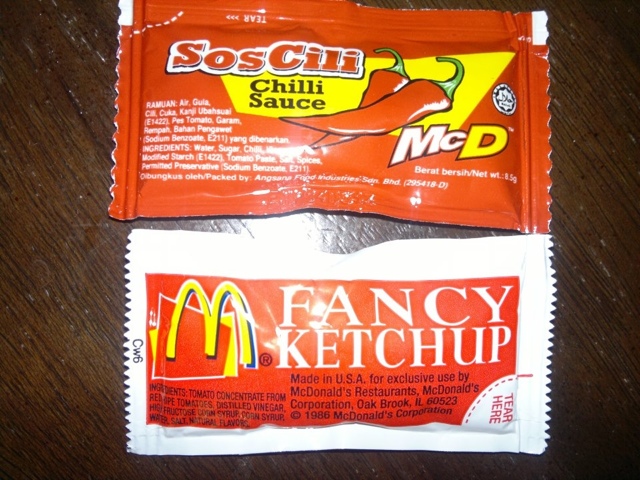
Non Halal McDonald Ketchup

Hi guys... Here I just want to remind you that there is a non halal (kosher) tomato or chilies ketchup were being served at McDonald restaurant franchise. So please do check it first before use. Thanks

Popular Posts

Related Posts Plugin for WordPress, Blogger...